

Most of us have never heard of shrews, and those who have, or have seen their images, probably think of them as another group of rodents or simply as some kind of long-nosed mouse. Despite being widespread and ecologically important, these small mammals remain poorly understood, with surprisingly little research devoted to them.
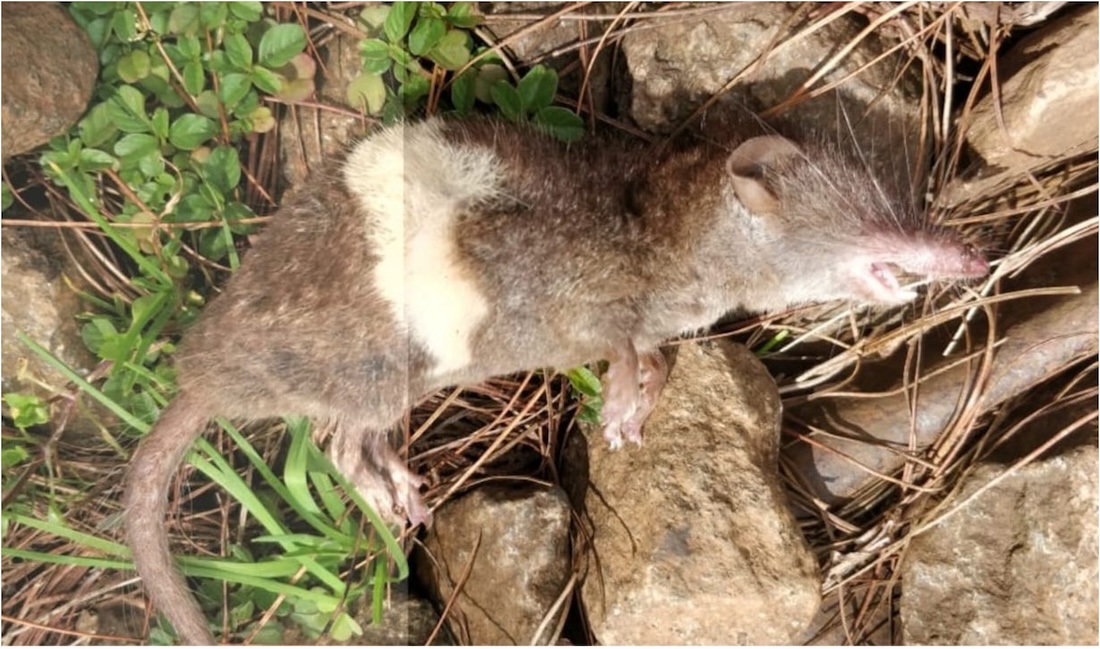
However, interest in shrews in India has been recently revived following a photograph taken in the Nilgiris of Tamil Nadu by a team of researchers, including Dr. Arockianathan Samson of the Bombay Natural History Society (BNHS). After a careful examination of the photograph, captured on October 1, 2022, scientists believe the image depicts Sonnerat’s shrew, a species previously thought to be extinct. The species is named after Pierre Sonnerat, a French naturalist who first described it around 1813 in Puducherry (Pondicherry). Until the 2022 discovery, Sonnerat’s original sketch was the only known visual record of the species.

However, before delving into the details of the discovery, let us first explore some basic facts about shrews.
What Are Shrews?
True shrews, such as Sonnerat’s shrew (Diplomesodon sonnerati), belong to the order Eulipotyphla and the family Soricidae. They are closely related to moles and hedgehogs as members of the same order. Unlike rodents, shrews do not possess prominent gnawing front incisors; instead, they have sharp, spike-like teeth.
These animals have a nearly worldwide distribution, comprising 385 species in 26 genera. Typically the size of a mouse, these mammals occupy a variety of habitats and have a wide diet base. The Asian house shrew (Suncus murinus) is the largest member of Soricidae at around 15 cm long, while the Etruscan shrew (Suncus etruscus), with a length of just about 3.5 cm, is the smallest.
Historical Records Of Sonnerat’s Shrew
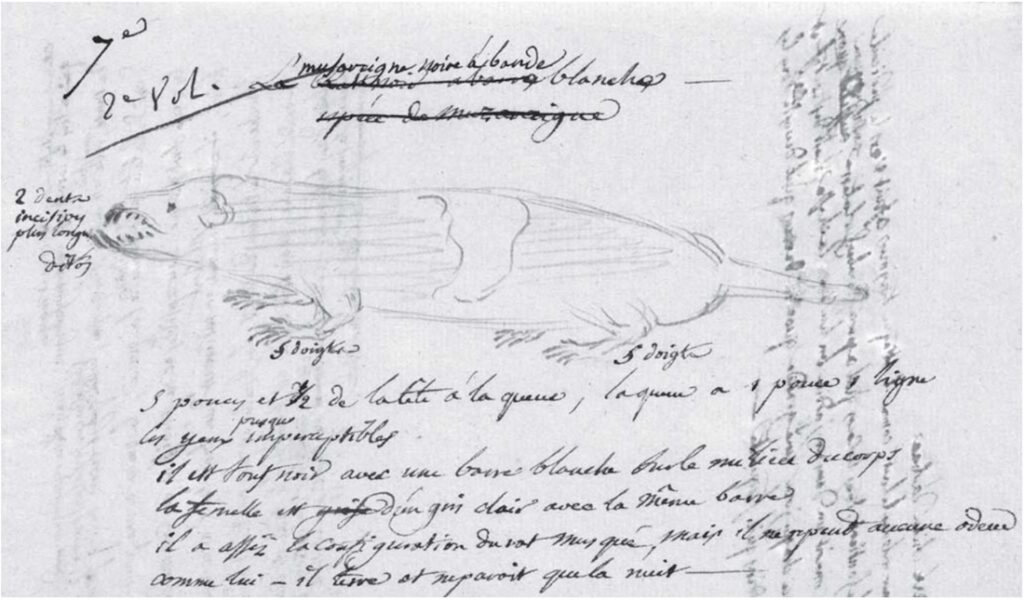
(from Cheke 2012, published with permission of the New South Wales State Library).
Sonnerat’s Shrew is a species that is shrouded in mystery. As mentioned earlier, the sketch by Sonnerat was the only known visual representation of the species. As described by him, the males of the species have a shiny black pelage, while females are grey, and both genders have a white patch in the middle of the back.
The placement of the animal in the Diplomesodon genus is purely based on morphological traits, primarily its pelage similarity with Diplomesodon pulchellum, an extant shrew species found in parts of Central Asia. However, it is larger than the Central Asian species. Also, according to Sonnerat’s notes, Sonnerat’s Shrew is larger than the Asian house shrew (Suncus murinus), another species found in India and native to South and Southeast Asia. Nevertheless, the lack of sufficient data prevents these observations from being conclusively confirmed.
The New Discovery
On October 1, 2022, a team of researchers conducting wildlife surveys in the Upper Nilgiris came upon a dead shrew by a railway track close to a small wetland patch near Ooty Lake in Udhagamandalam (Ooty) in Tamil Nadu. They captured a couple of photographs of the animal. However, they did not collect the specimen. Later, while trying to identify the species, they were unable to find similarities with other known shrew species in the region, namely the endangered Kelaart’s long-clawed shrew (Feroculus feroculus), the Asian house shrew (Suncus murinus), and the Asian highland shrew (Suncus montanus). The animal in the photograph had a grey pelage with a white patch running across the middle of the body. The tail was short and stubby. The description was consistent with that described by Sonnerat in his notes about Sonnerat’s Shrew.
For further clarification, the team shared the photographs with experts in both India and abroad. Among them were Anthony Cheke, a shrew specialist who had originally described the taxon, and Paula Jenkins, a British zoologist and curator at the London Natural History Museum, who specialises in mammals. The experts helped rule out the possibility that the white patch resulted from partial leucism and instead supported the conclusion that the animal photographed was possibly a Sonnerat’s shrew.
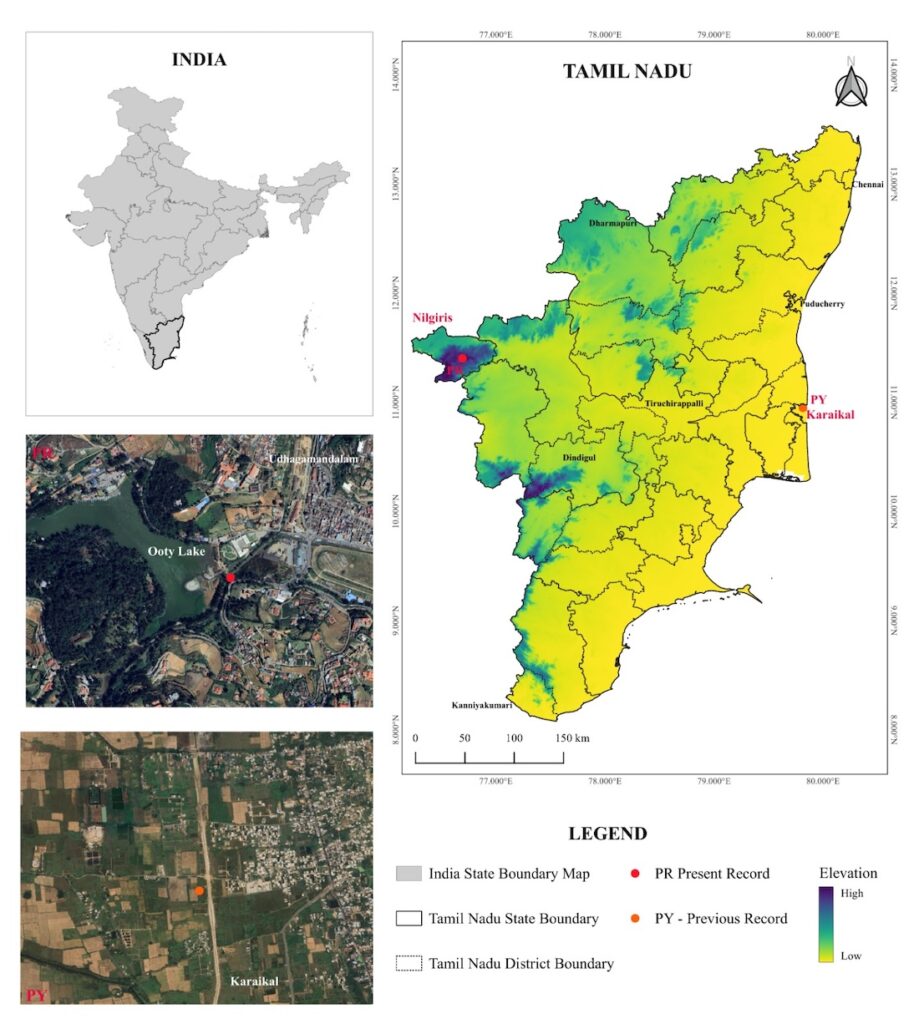
To confirm the identification, the researchers conducted extensive surveys in and around the area where the dead shrew was discovered. However, no additional specimens were captured in the traps set for the species. As the original record of Sonnerat’s shrew was approximately 350 km from this location in the lowland region, the researchers concluded that the animal may have reached the area through accidental transport from its actual habitat. Thorough surveys are needed in such areas for the species.
Hope Revived
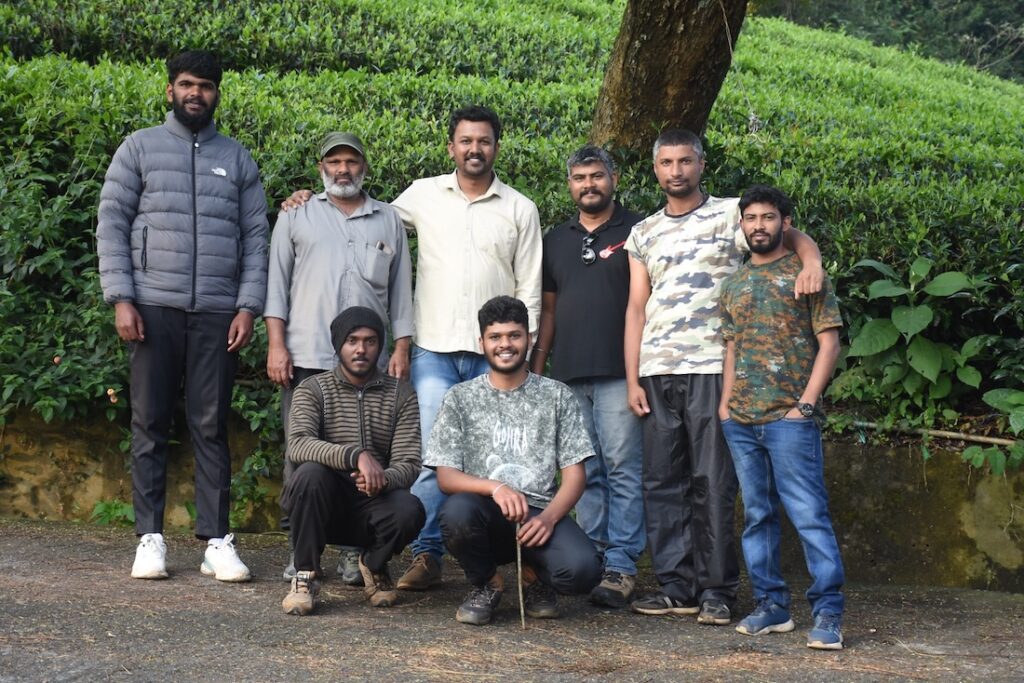
Moinudheen Nizamudheen (third from left top row), Samson Arockianathan (fifth from left top row) and
Abinesh Anbazhagan (sixth from left top row).
The possible rediscovery of Sonnerat’s shrew brings a ray of hope for the conservation of threatened species.
“Every species plays a vital role in the ecosystem, and so does Sonnerat’s shrew. The possible rediscovery of the species gives us new hope about this much-neglected group of mammals,” said Dr. Arockianathan Samson, Centre Manager, Vulture Programme, BNHS. He is also one of the co-authors of the publication “Rediscovery of an ‘extinct’ endemic mammal Sonnerat’s Shrew (Diplomesodon sonnerati Cheke, 2012) in Nilgiris, Tamil Nadu, India” published in the Iranian Journal of Animal Biosystematics (IJAB), based on the new discovery.
Thus, in a world where many existing species are racing towards extinction, this new hope is a reason to rejoice.
Feature image: Photograph of Sonnerat’s shrew (Diplomesodon sonnerati) in Nilgiris, Tamil Nadu, India, October 2022. Image by Sirajudeen Mohammed Shahir.